
Will You Have Enough
to Retire?
Simple tools and straightforward guidance to help you see where you stand — and what steps may come next.
No jargon
Free to use
Takes ~5 minutes
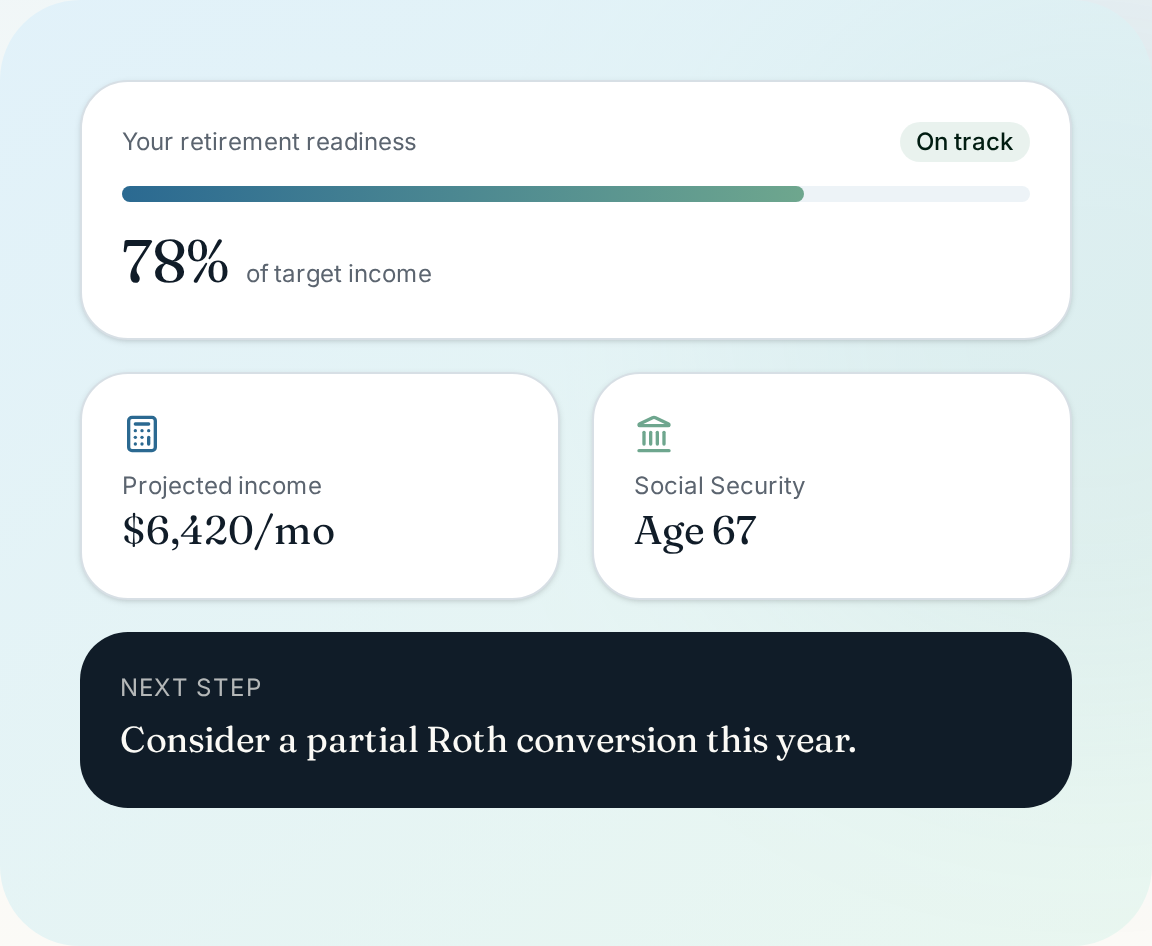
Tools built to keep things simple
WHY THIS SITE EXISTS
Retirement planning, finally translated into plain English.
Most financial sites are built to impress other financial people. This one isn't. It was built to help you — and your spouse, if you have one —
talk through the real question: will we have enough? Use the tools below to get a quick read on where you stand, then decide if a conversation makes sense.
Retirement Assessment Survey
The assessment asks a series of short questions about your savings, income, expenses, and goals to give you a personalized picture of your retirement readiness. It takes about five minutes and requires no financial expertise.
Retirement Calculator
The calculator lets you enter your own numbers, including savings, expected income, retirement age, and spending, to see whether you're on track. Adjust your inputs and see results in real time.
THE POINT ON ALL OF THIS
A retirement that feels like yours — not a spreadsheet.
The numbers matter because the life behind them matters. We help you connect the two.
Retirement Assessment Survey
The assessment asks a series of short questions about your savings, income, expenses, and goals to give you a personalized picture of your retirement readiness. It takes about five minutes and requires no financial expertise.
Retirement Calculator
The calculator lets you enter your own numbers, including savings, expected income, retirement age, and spending, to see whether you're on track. Adjust your inputs and see results in real time.
HOW IT WORKS
Three simple steps
01
Answer a Few Simple Questions
Take the Retirement Assessment or use the calculator. Either way, you'll only need a few minutes and some basic information about your savings and goals.
02
Review Your Results
See a clear picture of where you stand, what you're on track for, where there may be gaps, and what factors matter most for your situation.
03
Schedule a Conversation
If you'd like to go deeper, Scott Farrow is available to walk through your results and discuss next steps. No obligation, no pressure.
WHAT WE COVER
Topics worth understanding
Retirement Planning
Build a clear, written plan for the next chapter — not just a number on a spreadsheet.
Roth Conversions
Decide if converting traditional savings to Roth could lower lifetime taxes.
Retirement Income Planning
Turn your savings into a steady paycheck you can actually live on.
Tax-Efficient Retirement Strategies
Small adjustments to where money comes from can mean big tax savings.
Social Security Planning
When you claim matters. We'll help you weigh the trade-offs together.
About
Guidance from Scott Farrow of Farrow & Associates
Scott has spent his career helping families translate financial complexity into real-life decisions. The tools on this site reflect the same conversations he has every day — focused on clarity, not jargon, and on what's actually right for you.

FAQ
Common questions about retirement
The questions we hear most often from people trying to figure out if their plan really works.
How do I know if I will have enough to retire in Wisconsin?
The clearest way to know if you'll have enough to retire is to run a personalized retirement projection that factors in your savings, expected Social Security benefits, pension income, healthcare costs, and desired lifestyle. Wisconsin retirees also need to account for state income tax on retirement income and the cost of living in their specific community, since expenses in the Milwaukee suburbs differ from more rural areas. A financial advisor can stress-test your plan against market downturns, inflation, and longevity risk so you aren't relying on guesswork. Rather than a single savings number, the right answer depends on your spending needs and timeline, which is why a customized assessment is far more reliable than generic retirement rules of thumb.
What is a good retirement savings amount for someone in Wisconsin?
There isn't one universal number, because a good retirement savings amount depends on your desired annual income, expected Social Security benefit, healthcare needs, and how long your money needs to last. A common starting benchmark is having 10 to 12 times your final salary saved by retirement age, but this can vary significantly based on whether you'll have a pension, when you plan to retire, and your Wisconsin cost of living. Some retirees need less if they've paid off their mortgage and downsized, while others need more if they plan to travel or support family. Working with an advisor to model your specific numbers is far more accurate than relying on a one-size-fits-all savings target.
At what age can I retire comfortably in Wisconsin?
Comfortable retirement age depends more on your savings, income sources, and spending plan than on a specific birthday. Many people target full Social Security retirement age, which is 66 to 67 depending on birth year, to maximize benefits, while others retire earlier by drawing down savings or part-time income to bridge the gap. Wisconsin retirees should also consider healthcare coverage before Medicare eligibility at 65, since early retirees often need to budget for private insurance. A retirement readiness assessment can show whether retiring at 60, 62, 65, or later still allows your savings to last through your expected lifespan, factoring in inflation and market volatility along the way.
What are the biggest retirement planning mistakes to avoid?
Common mistakes include underestimating healthcare and long-term care costs, claiming Social Security too early without a strategy, failing to account for Wisconsin state income tax on retirement withdrawals, and not having a plan to manage sequence-of-returns risk if the market drops early in retirement. Many people also overlook the tax impact of required minimum distributions from traditional retirement accounts, which can push them into a higher bracket later in life. Another frequent error is not updating the plan as life circumstances change, such as a spouse's health, an inheritance, or a career change. Working with a retirement-focused advisor helps you avoid these pitfalls before they affect your financial security.
Do I need a financial advisor to plan for retirement in Wisconsin?
While it's possible to plan for retirement on your own, a local Wisconsin financial advisor brings expertise in state-specific tax rules, Social Security optimization, healthcare cost planning, and investment strategy that can be difficult to coordinate independently. An advisor can also provide an objective, unemotional perspective during market volatility and help you avoid costly timing mistakes. For retirees with more complex situations, such as business ownership, multiple income sources, or a desire for tax-efficient withdrawal strategies like Roth conversions, professional guidance often pays for itself. If you're unsure where you stand, a complimentary retirement readiness assessment is a low-risk way to get clarity.
Ready to Find Out Where You Stand?
It only takes a few minutes — and you'll get a clearer picture of what comes next.